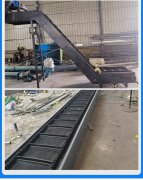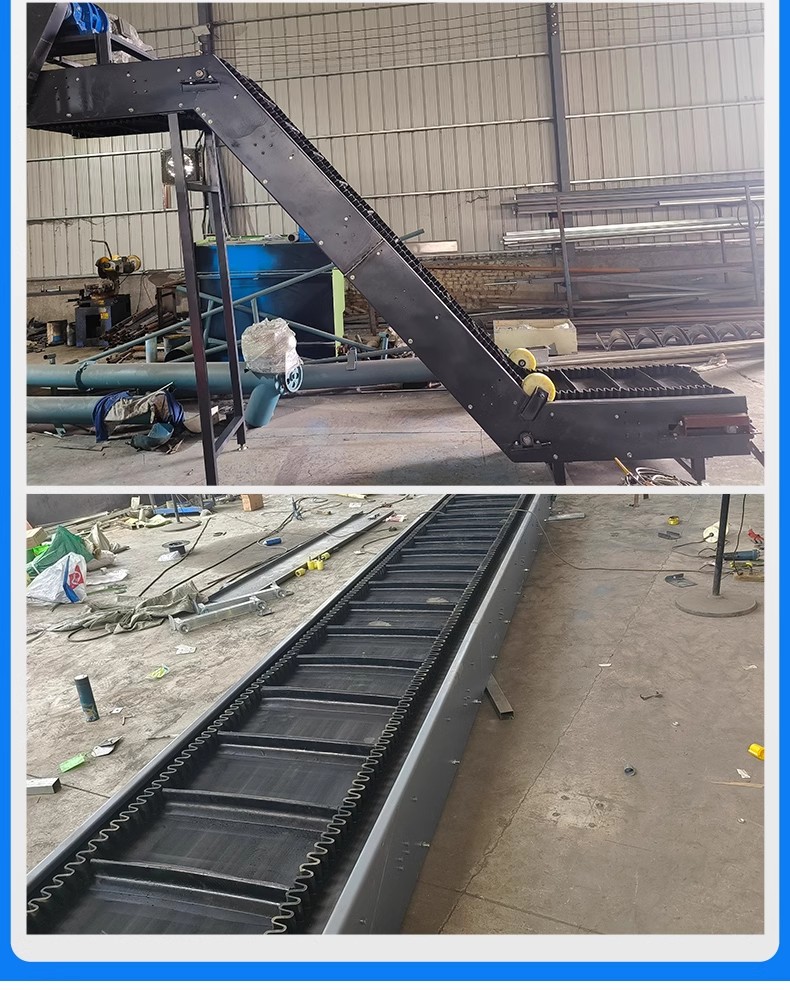
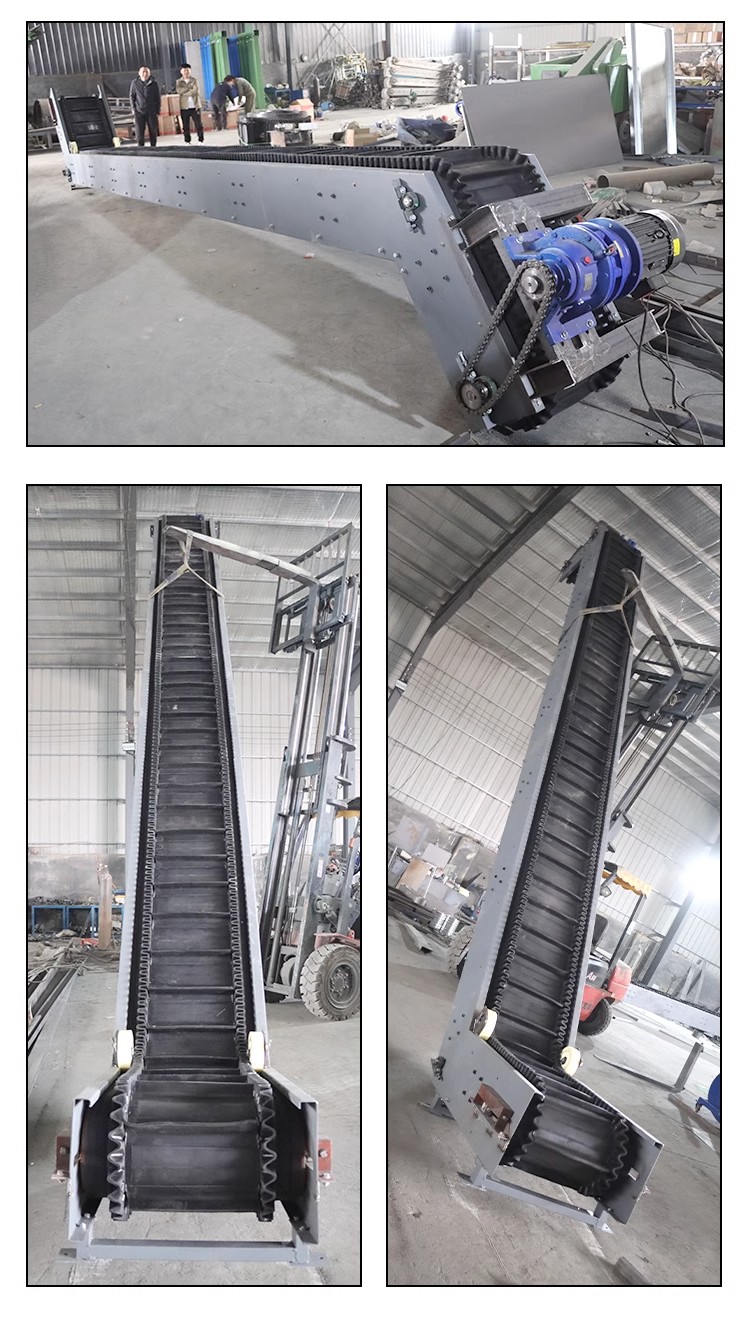

Large Incline Conveyor, Z-Type High Sidewall Climbing Conveyor, Large Angle Sidewall Cleated Conveyor
Large Incline Belt Conveyor
Large incline belt conveyor is mainly used for continuous steep-angle transportation of bulk materials. It adopts conveyor belts with corrugated sidewalls and transverse cleats, with conveying inclination ranging from 0° to 90° (preferably below 70°). It is widely applied in coal, grain, building materials, chemical, hydropower, agriculture, port, metallurgy and other industries. For materials with special requirements, such as high-temperature materials or materials containing acid, alkali and oil substances, special design with corresponding materials can be provided as required. It retains the advantages of ordinary belt conveyors including high reliability in horizontal or small-angle conveying, energy saving, reliable and economical material lifting.
Large incline belt conveyors mainly include patterned belt conveyors / deep trough belt conveyors, corrugated sidewall belt conveyors, pressure belt conveyors and so on.
Large incline belt conveyors are suitable for uphill inclination over 18° and downhill inclination over -16° in tunnels. Steel cord conveyor belts, deep trough idler sets, soft starters and power balance systems are generally required. Patterned conveyor belts and brush scrapers shall be adopted when the conveying inclination exceeds 28°.
Main Features:
-
Patterned belt or deep trough belt conveyor can realize material conveying at lifting angles from 16° to 32°. Compared with other types of large incline belt conveyors, it has simple structure and reliable operation.
-
Corrugated sidewall belt conveyor: It uses specially structured conveyor belts designed for steep-angle material transportation, with lifting angle up to 90°. It runs smoothly and reliably with low noise and low energy consumption.
-
Corrugated sidewall belt conveyor is a special belt conveyor capable of bulk material transportation at large inclination angles or even vertical lifting. Its structure is basically similar to general belt conveyors. The main difference lies in the specially manufactured corrugated sidewall conveyor belt.
-
The corrugated sidewall conveyor belt is made by bonding flexible, stretchable S-shaped or W-shaped rubber corrugated sidewalls of different heights on both sides of a standard conveyor belt (fabric core belt or steel cord belt). Transverse cleats are bonded on the base belt between the two sidewalls at certain intervals for material carrying.
-
The cross-section of transverse cleats can be T-type, C-type or TC-type.
-
The conveyor inclination angle can vary from 0° to 90°. The conveying path is usually arranged in Z-shape, L-shape, C-shape or straight line. Both loaded idlers and return idlers of the conveyor are flat idlers. Counter pressure wheels press the two side edges of the belt, enabling quick transition of the conveying path from horizontal to inclined (or vice versa). Just like patterned belt conveyors, it is difficult to remove materials sticking to corrugated sidewall belts. Vibrating wheels or vibrating devices are commonly used to vibrate the belt up and down to remove adhered materials.
-
This type of conveyor can realize large-angle conveying to reduce floor space. Compared with bucket elevators, it features larger conveying capacity, lower energy consumption and easier maintenance. Therefore, it is widely used in mines, large open-pit mines, power plants, cement plants, ports and other sites.
 WhatsApp